Subtotal ₨ 0





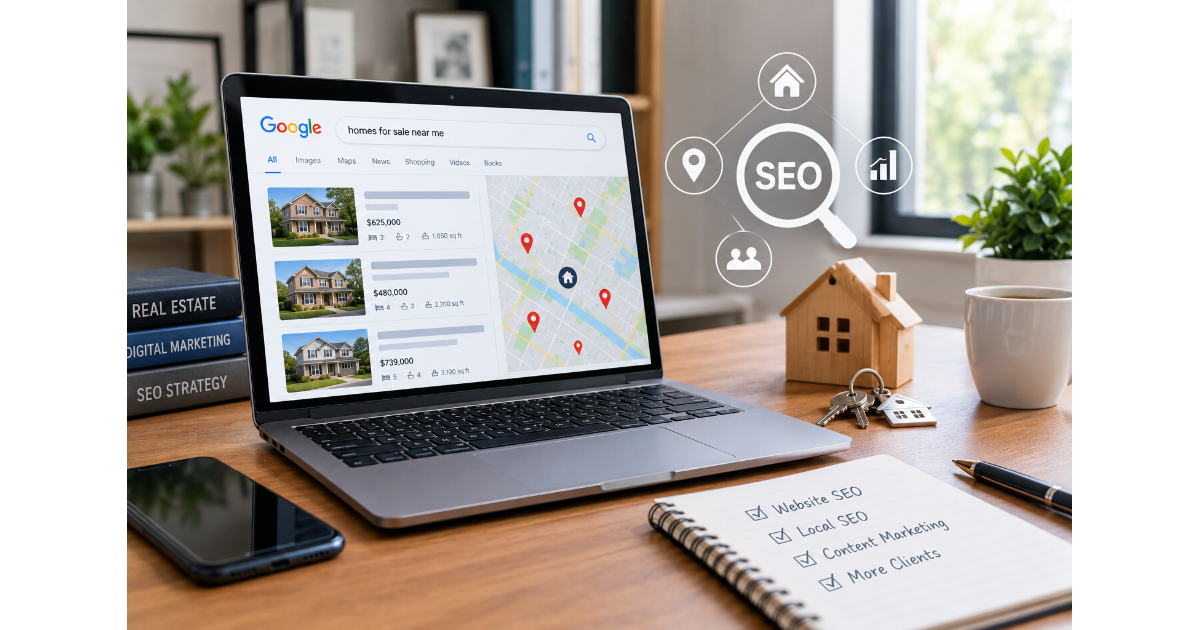
If your listings are not showing up when someone searches “homes for sale” or “realtor near me,” you are losing buyers and sellers to agents who simply show up first on Google. That is the reality of real estate today. Most buyers start their search online long before they ever call an agent, scrolling through listings on their phone at midnight, comparing neighborhoods, checking a mortgage calculator, and quietly deciding who they trust enough to call first. SEO, search engine optimization, is what determines whether that first call goes to you or to the brokerage three blocks away with a better-optimized website. This guide breaks down exactly what real estate SEO looks like in practice, from building buyer and seller focused content to ranking for specific neighborhoods and property types, without drowning you in technical jargon you do not actually need to know.

Why SEO Is Different for Real Estate Than Most Industries
Real estate is unusual because the product changes constantly. A listing that ranks beautifully today might be sold and gone next week, which means your SEO strategy cannot rely purely on individual property pages staying relevant forever. Instead, the smartest real estate agents build their SEO around themselves and their expertise as much as around any single listing, local real estate market updates, neighborhood guides, and buyer or seller advice that stays useful long after a specific house sells. This is also a deeply local business. Nobody searching for a realtor near me in one city cares about your rankings in a city three states away, so your entire SEO approach needs to be built around geography from the very first page you write.
Building Your Website Around Real Estate Listings and Trust
Your website needs to do two jobs at once: showcase real estate listings clearly and convince a visitor that you are the best real estate company to work with, not just another name on a long list. This means your homepage should not just be a search bar dumped on a page. It needs real content explaining who you are, what areas you cover, and why buyers and sellers in your market choose you. Pair this with a clean, fast listings page that lets visitors filter houses for sale by price, neighborhood, and property type without frustration. Search engines reward sites that keep visitors engaged and clicking around rather than bouncing straight back to Google, so a well-organized site is not just good manners toward your visitors, it is genuinely good for rankings.
Content for Buyers: Meeting Them Where They Are in the Process
Buyers rarely arrive ready to make an offer on day one. Most are somewhere in a long research phase, and your content should meet them at every stage of that journey. Write dedicated pages and posts around how to buy a house in your area, covering the local process from pre-approval through closing. Build out content for specific buyer needs too, single-family homes for sale, new construction homes, and first-time home buyer programs available in your region, since first-time buyers in particular are often searching for reassurance as much as listings. A simple, practical house hunting checklist performs surprisingly well because it is genuinely useful and easy to share. Do not ignore the practical side either; a page featuring open houses this weekend or move-in ready homes near me captures buyers who are ready to act right now, while affordable homes for sale content captures a huge segment of buyers working within a tighter budget who feel underserved by listings that only showcase luxury properties.
Content for Sellers: Answering the Questions They Ask Before They Call
Sellers approach your site with a very different mindset than buyers, and your content needs to reflect that. The most searched phrase in this entire category is some version of sell my house or how much is my house worth, so a clear, easy-to-use home valuation tool or request form should be prominent on your site, not buried three clicks deep. Write honestly about the cost of selling a house, including commissions, repairs, and closing costs, since vague or evasive pricing content pushes sellers toward agents who are more transparent. Cover practical topics like tips for selling a home and how to increase home resale value, since sellers genuinely want to know what is worth fixing before listing and what is a waste of money. If you offer options like a flat fee MLS listing, or if you work with clients considering we buy houses for cash offers, address these honestly rather than avoiding the topic, since sellers researching these terms are actively comparing their options and will remember which listing agent gave them a straight answer. A seasonal piece on the best time to sell a house in your specific market also tends to perform well, since timing is one of the first questions almost every seller asks.
Do’s and Don’ts of Real Estate SEO
| Do | Don’t |
|---|---|
| Build dedicated pages for each neighborhood you serve | Rely on one generic “areas we serve” page for your entire market |
| Keep listings updated and remove sold properties promptly | Leave outdated or sold listings live, which frustrates visitors and hurts trust |
| Write honestly about costs, commissions, and closing fees | Avoid pricing topics entirely and hope visitors call to ask |
| Publish local market updates on a regular schedule | Post generic national real estate news with no local relevance |
| Optimize your Google Business Profile with accurate service areas | Leave your profile outdated or incomplete |
| Use real photos of neighborhoods and properties you have sold | Rely only on stock photography that could belong to any city |
| Link buyer and seller content together where it makes sense | Build isolated pages with no connection to the rest of your site |
Ranking for Specific Property Types and Niches
Generic real estate content only gets you so far, because plenty of agents are already competing for broad terms like realtor near me. The real opportunity often lives in more specific property types. If you handle luxury real estate, build content that genuinely reflects that market, high-quality photography, discretion around pricing, and language that speaks to that buyer’s expectations. The same logic applies to condos for sale, townhomes for sale near me, and land for sale, each of these buyers has different priorities and questions, so separate, focused pages perform far better than folding everything into one listings feed. Commercial real estate deserves its own dedicated section entirely, since commercial property for lease searches come from an almost entirely different audience than residential buyers. Niche categories like gated communities, waterfront homes for sale, investment properties for sale, multi-family homes for sale, and fixer-upper homes near me are often under-served by competitors, which makes them genuinely valuable targets if they match what you actually sell.

Neighborhood and Location Pages: The Backbone of Local Real Estate SEO
This is arguably the single most important category of content for any local agent or brokerage. Every meaningful area you serve deserves its own page built around homes for sale in that specific neighborhood, written with real local knowledge rather than generic filler. Cover what actually matters to someone considering moving there, best neighborhoods nearby, the general cost of living, local school districts, and honest real estate trends specific to that pocket of the market. A buyer searching for a realtor in a particular suburb wants to see proof that you actually know that area, not just that your name appears on a broad citywide list. These pages also tend to have a long shelf life, since neighborhood character and school district reputation change slowly, which means a well-written location page can keep bringing in steady traffic for years with only occasional updates.
Advantages and Disadvantages of Different Real Estate SEO Approaches
| Approach | Advantages | Disadvantages |
|---|---|---|
| Individual Agent Website | Personal branding, direct control over content | Smaller domain authority, slower to build trust with search engines |
| Brokerage-Wide Website | Higher domain authority, shared resources | Individual agents can get lost among many profiles |
| Third-Party Listing Portals | Instant traffic and visibility | Little control over branding, shared with every competitor |
| Local Blog and Neighborhood Content | Builds long-term authority and trust | Takes time and consistency to show real results |
| Paid Search Alongside SEO | Immediate visibility while SEO builds | Costs stop the moment you stop paying |
Informational Content That Builds Long-Term Authority
Beyond listings and neighborhood pages, a steady stream of genuinely useful blog content is what separates agents who dominate search results from those who quietly disappear after a few months of effort. Write about real estate investing tips for buyers considering rental properties, and break down the home buying process step by step for people who have never done this before. A clear selling a home checklist helps sellers feel organized rather than overwhelmed. Answer the specific questions people are actually typing into Google: what is a pre-approval letter, closing costs explained for buyers, how to stage a house for a fast sale, the honest for sale by owner pros and cons, and what fixes are mandatory after a home inspection. None of these need to be long, dense articles. Short, direct, genuinely helpful answers tend to rank better than sprawling generic posts, because they match exactly what the person typing the question wants to know right now.
Local Signals That Search Engines Actually Trust
Content alone will not get you to the top of local search results. Search engines lean heavily on signals like a complete, accurate Google Business Profile, consistent name and contact information across every directory you appear on, and genuine reviews from past clients. A find a real estate agent search often pulls directly from these local business signals before it even reaches your website, so this groundwork matters just as much as the content itself. According to the National Association of Realtors, the vast majority of home buyers begin their search online, which underscores just how much weight your digital presence carries before a buyer ever picks up the phone (source: <a href=”https://www.nar.realtor”>National Association of Realtors</a>). Pair a strong local profile with genuine client testimonials and a handful of active, well-maintained directory listings, and you build the kind of trust signals that search engines and human visitors both respond to.
Technical Basics That Quietly Make or Break Your Rankings
None of the content strategy above matters much if your website itself is slow, confusing, or broken on mobile devices. Most buyers and sellers are browsing on their phones, often while out running errands or lying in bed at the end of a long day, so a site that loads slowly or requires constant pinching and zooming will lose visitors within seconds. Make sure your listings load quickly, your contact forms actually work, and your site structure uses clear, descriptive headings that match how people search, rather than clever real estate jargon that means nothing to a first-time buyer. The U.S. Department of Housing and Urban Development offers consumer-facing resources on the home buying process that many agents reference when building trustworthy, informational content for their own sites U.S. Department of Housing and Urban Development. Clean technical fundamentals paired with genuinely helpful content is what quietly separates the agents who rank consistently from the ones who wonder why their beautifully designed website never brings in a single call.

Bringing It All Together
Real estate SEO is not about chasing a single magic keyword or gaming the system with tricks that stop working after a few months. It is a steady combination of well-organized listings, honest buyer and seller focused content, real neighborhood expertise, and a technically sound website that respects the visitor’s time. Whether someone is searching for the best real estate company in town, quietly wondering how much my house worth is, or comparing single-family homes for sale across three different neighborhoods, your website’s job is to answer clearly and earn their trust before they ever pick up the phone. This takes real, sustained effort, but agents and brokerages who commit to it tend to build a steady, compounding stream of clients who found them through search rather than clients who only appeared because of an expensive ad campaign that stopped the moment the budget ran out. Start with your strongest neighborhood pages, build out honest buyer and seller content from there, and keep the technical basics clean. That combination is what actually moves a real estate website up the rankings and keeps your pipeline full.
